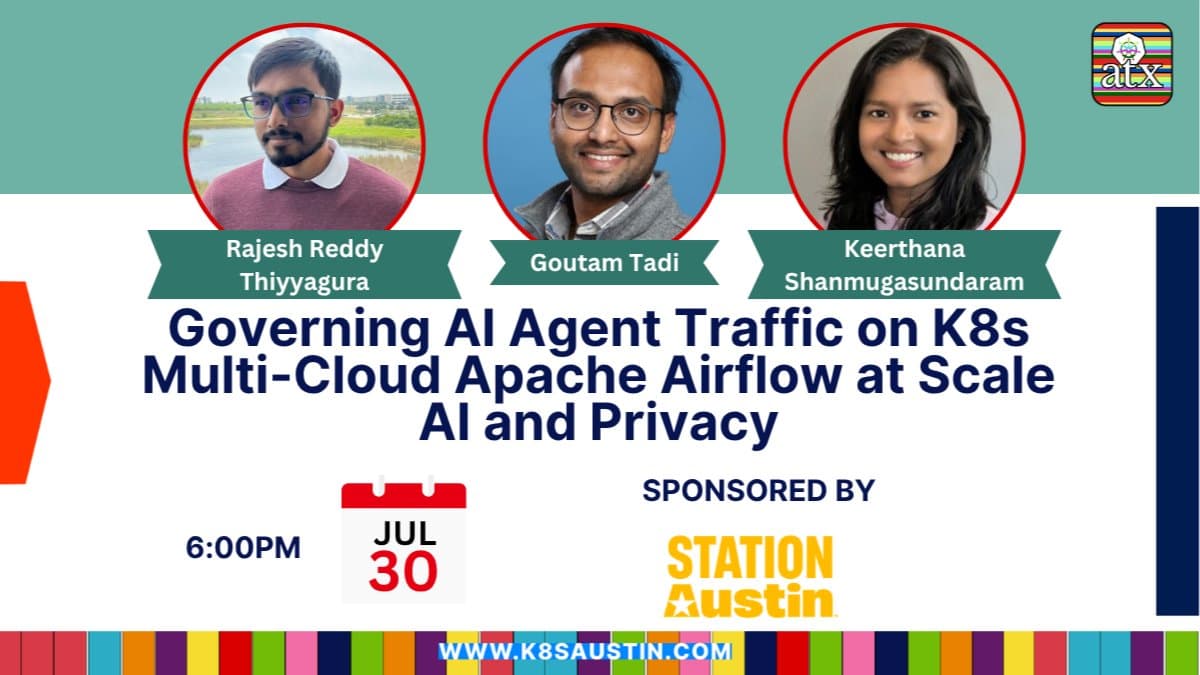
Governing AI Agent Traffic & Multi-Cloud Apache Airflow & AI and Privacy
📅 Thursday, July 30, 2026 at 11:00 PM
📍 Capital Factory · 701 Brazos St, Austin, TX
🆓 Free entry
Source: crawl:meetup-com
**July 30th at 6 pm at the Station Austin (formerly known as Capital Factory)** 701 Brazos Street, 16th Floor, Antones Room Austin, 78701 Schedule: 6:00-6:30 - Food+Social 6:30-7:00 - The Invisible Backdoor: Governing AI Agent Traffic on Kubernetes by **Rajesh Reddy Thiyyagura** 7:00-7:15 - AI and Privacy by **Keerthana Shanmugasundaram** 7:20-8:00 - Kubernetes-Powered Multi-Cloud Apache Airflow at Scale: The Astro Architecture by **Goutam Tadi** ### **We know parking in Downtown is tricky!** **So, you can park in the building garage for just $8.00 (validation parking tickets will be distributed)!** Street parking will still be an option. More information on parking here: [https://www.capitalfactory.com/parking/](https://www.capitalfactory.com/parking/) ### Please RSVP [here](https://ocgroups.dev/cncf/group/3up7rjk/event/t39gtdw) and please make sure you follow our official social media platforms and stay tuned for the latest news about Kubernetes Austin: https://linkedin.com/company/k8sAustin https://instagram.com/k8sAustin https://x.com/k8sAustin Everyone is invited to join! We hope to bring the latest news about the Kubernetes and CNCF projects. **Descriptions** **The Invisible Backdoor: Governing AI Agent Traffic on Kubernetes** Shadow IT used to mean files in Dropbox. In 2026 it’s a developer wiring an AI agent straight into your production database through an unmanaged server your security team can’t see. AI agents have become privileged actors inside our clusters, connected through two protocol layers — MCP (agent-to-tool) and A2A (agent-to-agent) — that both made authentication and authorization optional by design. The result is invisible, ungoverned infrastructure that doesn’t just leak data, it takes autonomous action: writing to databases, calling APIs, and chaining operations across systems. This talk maps both attack surfaces with real 2026 data, then walks a vendor-neutral, Kubernetes-native pattern to govern them with a single spine: discover what’s running, force all agent traffic through one control point, enforce least privilege at admission and at every call, and give each agent a verifiable workload identity — using network policy, admission control, the Gateway API, and SPIFFE/SPIRE. A live demo shows a shadow MCP server caught and blocked; A2A shows where this is heading. You’ll leave knowing how to find the agent infrastructure already running in your own clusters, and a pattern you can implement without buying a product. **AI and Privacy** As companies rapidly deploy massive LLMs into production, standard network security is no longer enough to protect sensitive user prompts. AI completely redefines the enterprise AI threat model, introducing unique vulnerabilities like prompt injection, data poisoning, and dynamic data exfiltration. This talk delivers a comprehensive, step-by-step architectural blueprint for enforcing automated "Privacy by Design" across your infrastructure using open-source CNCF tools. We will evaluate three primary privacy implementation options, including building centralized LLM Gateways for real-time PII masking, deploying Confidential Containers to shield data-in-use against root-level host exploits, and configuring policy engines like Kyverno or Gatekeeper to enforce strict data boundaries. **Kubernetes-Powered Multi-Cloud Apache Airflow at Scale: The Astro Architecture** Astro uses Kubernetes to orchestrate billions of Apache Airflow tasks monthly across hundreds of AWS/GCP/Azure clusters. The architecture features a control plane with cluster provisioning services and GitOps-based configuration management using K8s manifests. Custom operators in each data plane manage complete Airflow deployment lifecycles, including executors, auto-scaling, and databases. This operator-driven approach abstracts infrastructure complexity while enabling declarative management of diverse workloads from startups to enterprise scale. K8s provides a universal API layer across clouds, with advanced observability combining K8s-native monitoring and Airflow intelligence for automatic issue detection and remediation. The declarative, operator-based architecture proves that open-source K8s primitives can reliably scale to billions of tasks while maintaining operational simplicity through thoughtful abstraction of cloud provider differences. This talk dives deep into scale, security, real time issues and solutions, tools and techniques to help others in their kubernetes journey. More information: k8saustin.com